The number 666
What does the number 666 mean?
The number 666 is mentioned in the Bible as the "number of the beast" (Revelation of John, Chapter 13, Verse 18). The "beast" is an apocalyptic symbol of evil seeking to enslave humanity. Additionally, 666 is referred to as the "number of a human name," without further explanation.
In Hebrew, the original language of the Bible, letters also serve as numerals. However, due to countless combinations of letters that can be read as numerals, resulting in a sum of 666, it remains unclear which "human name" the Bible associates with the number 666.
Given the historical context at the time of the composition of the Book of Revelation, it is likely that the reference to 666 relates to the ancient Roman Emperor Nero.
What is the significance of 666 in the Bible?
The number 666 is mentioned in the Bible exactly three times. In the Book of Revelation, 666 serves as a symbol of evil. The other two instances associate the number 666 with the increase of wealth and the multiplication of offspring. This is likely due to a mathematical property of the number 666, as it is a triangular number.
- King Solomon's legendary annual income was 666 talents of gold (1 Kings 10:14 and 2 Chronicles 9:13)
- After the Jewish people returned from the Babylonian captivity, Adonikam had 666 sons (Ezra 2:13)
- The numerical value of the beast in the Book of Revelation is 666 (Revelation 13:18).
Is the number 666 a symbol for the Roman Empire?
The number 666 can be linked to ancient Rome due to the timeframe of the Book of Revelation (70-110 AD), as it corresponds to the sum of the first six digits in Roman numerals:
I + V + X + L + C + D =
1 + 5 + 10 + 50 + 100 + 500 =
666
The early Christians were Jews who spoke Hebrew. The Roman Emperor Nero (37-68 AD) is called נרון קסר (Neron Kesar) in Hebrew. Since Hebrew letters also serve as numerals, the sum of these numerals is 666. Nero was notorious for his brutality and cruelty. He executed his closest relatives and used the devastating fire in ancient Rome as a pretext for brutal persecutions of Christians, among whom Peter is said to have been a victim. Peter was one of the twelve apostles of Jesus and the first Pope. Additionally, Nero ordered a prolonged war in the Holy Land, during which the famous Second Temple in Jerusalem was plundered and destroyed. It has not been rebuilt to this day, and its remains are revered by Jews as the "Western Wall" or "Wailing Wall."
What other meanings does the number 666 have?
- In mathematics, 666 is the 35th triangular number
- In modern popular culture, it is often associated with the phonetic similarity between "Six" and "Sex."
- Additionally, pop stars frequently pose with a hand gesture forming the number 666 in front of the eye
- The number 666 has also become a symbol for conspiracy theories
And I saw another beast rising out of the earth. It had two horns like a lamb, but it spoke like a dragon. It exercised all the authority of the first beast in its presence, and it made the earth and its inhabitants worship the first beast, whose mortal wound was healed. It performed great signs, even making fire come down from heaven to earth in front of people. It deceived the inhabitants of the earth by the signs it was allowed to work in the presence of the beast, telling them to make an image for the beast that was wounded by the sword and yet lived. And it was allowed to give breath to the image of the beast, so that the image of the beast might even speak and might cause those who would not worship the image of the beast to be slain. Also, it causes all, both small and great, both rich and poor, both free and slave, to be marked on the right hand or the forehead, so that no one can buy or sell unless he has the mark, that is, the name of the beast or the number of its name.
This calls for wisdom: let the one who has understanding calculate the number of the beast, for it is the number of a man, and his number is 666.
The Revelation of John
The Book of Revelation, also known as the Revelation of John or the Apocalypse, is part of the New Testament and the final book of the Bible. The author identifies himself as John, though it is unclear whether he is the disciple of Jesus with the same name. It is also uncertain if he is the same person as the author of the Gospel of John. The exact date of the composition of the Book of Revelation is disputed, but it is generally placed between 70 and 110 AD.
The text contains numerous symbols, allegorical representations, and prophetic statements. The author, John, addresses his revelation to the seven Christian communities in Asia Minor mentioned in the preface of the text. Using vivid language, he describes a chronological series of apocalyptic visions and prophecies that he is said to have received during his exile on the island of Patmos. Core themes include:
- The imminent end times
- The coming of the Antichrist
- The Day of Judgment
- The final battle between good and evil, culminating in the triumph of good
- The establishment of the new Kingdom of God
Overall, the Book of Revelation explores the promise of redemption and eternal life for those who believe in Jesus Christ.
Contemporaries initially interpreted the Book of Revelation as applicable to their present time. However, when the prophecies did not come to pass, such as the reappearance of Jesus Christ, the church fathers deferred the predicted events to an indefinite future.
The visions themselves do not mention historical figures, events, or specific dates. Instead, they employ symbols, descriptions, and periods of symbolic duration, such as 1000 years, 1260 days (equivalent to 3.5 revolutions of a circle of 360°), 42 months (3.5 years), etc. The use of 3.5 is half of seven, with seven representing the perfect creation that, according to the first book of the Bible, God achieved in seven days. Therefore, 1260 and 42, as multiples of 3.5, are allusions to the imperfect or precisely half-perfect.
This calls for wisdom: let the one who has understanding calculate the number of the beast
The number value of a word
In the Book of Revelation, the number 666 is referred to as the number of a human name and is said to represent the numerical value of the beast. This can be somewhat confusing from a modern perspective.
The numerical value of a word is the sum of the numeric values of the letters in that word. The assignment of numerical values varies depending on the script culture. Often, it corresponds to the position of the letter in the respective alphabet but could also be traditionally defined.
During the time of the Book of Revelation, three ancient script systems were prevalent in the area now known as Israel: Ancient Greek, Roman-Latin, and Hebrew. In all three script systems, letters also served as numbers, allowing words to correspond to numbers and vice versa. While in the Roman-Latin script system, only selected letters represented numbers, in both the Ancient Greek and Hebrew scripts, all letters had numeric values. Roman numerals were predominant in Europe for a long time, only being replaced by Arabic numerals (0-9) in the 12th century.
Example in the Modern Latin Alphabet
Take the word "JOHN" as an example. The letter J is the tenth letter in the alphabet and has a value of 10, O is the fifteenth letter with a value of 15, H is the eighth letter with a value of 8, and N is the fourteenth letter with a value of 14. Therefore, the word "JOHN" would have a numerical value of 47 (= J+O+H+N = 10+15+8+14).
Example: Roman-Latin
In the Roman-Latin script system, numbers 1-1000 were represented by the letters I (1), V (5), X (10), L (50), C (100), D (500), and M (1000). Hence, English words like I'M, LID and MIX can also be read as Roman numerals.
| English word from Roman numerals | Addition of the individual digits | Sum of the digits (numerical value) | Equivalent in the Roman numeral system |
| I'M | 1+1000 | 1001 | - |
| LID | 50+1+500 | 551 | - |
| MIX | 1000+1+10 | 1011 | 1009 |
In Roman numerals, individual digits must be arranged according to strict rules. Therefore, only MIX is indeed a number in ancient Roman writing style and corresponds to the number 1009. IM or DILL would not have been considered numbers by the Romans, even though the individual letters correspond to Roman numerals.
Example: Ancient Greek and Hebrew
The ancient Greeks and the Jews used the Milesian system for representing numbers. There are some peculiarities in these scripts that won't be further discussed here. The important point is that every Ancient Greek or Hebrew word can be read as a number. In general, each alphabet was divided into three groups of nine letters, corresponding to the units, tens, and hundreds places, which was sufficient for everyday use. Additionally, there are additional numerical symbols. A special feature of the Hebrew script is that it is read from right to left.
| Example in Hebrew: | ||||
| English Spelling | Hebrew Script | Hebrew Letters/ Digits | Numeric Values of Letters | Sum |
| House | בית | ת (Taw), י (Jod), ב (Beth) | 400 + 10 + 2 | 412 |
| Example in Ancient Greek: | ||||
| English Spelling | Ancient Greek Script | Ancient Greek Letters/ Digits | Numeric Values of Letters | Sum |
| House | οἶκος | ο (Omikron), ἶ (Iota), κ (Kappa), ο (Omikron), ς (Sigma) | 70 + 10 + 20 + 70 + 200 | 370 |
The numerical value of 666
It is now clear what the Book of Revelation means by the numerical value of a word. On the other hand, it is evident that there are numerous words that, when summed, result in the number 666. Without further information, it is therefore impossible to attribute the number 666 to a specific name. The relevant Bible passage provides no additional details:
"[The beast forced all], to put a mark on their right hand or on their forehead so that no one could buy or sell unless they had the mark, which is the name of the beast or the number of its name. This calls for knowledge. Let the person who has understanding calculate the number of the beast, for it is the number of a man. That number is 666."
Both the name of the beast and the human name are unknown. Only the numerical value of both names is given as 666. It is left open whether the name of the beast and the human name are the same.
For it is the number of a human name. Its number is six hundred and sixty-six
The Roman occupation of Judea
At the time of the New Testament's creation, particularly the Book of Revelation, between 70 and 95 AD, Israel was the province of Judaea, occupied by the Roman Empire from 63 BC to 395 AD. There were recurrent uprisings against Roman rule, all of which failed due to the overwhelming power of the adversary. The last major uprising was the Jewish War of 66-73 AD, concluding with the Roman conquest of the mountain fortress Masada. In the course of the conflict, in the year 70 AD, the highest Jewish temple in Jerusalem was destroyed, and its remnants are revered by Jews today as the Western Wall.
Roman numerals
When the first six Roman numerals are added, the result is 666.
| I | V | X | L | C | D | I V X L C D |
| 1 | 5 | 10 | 50 | 100 | 500 | 666 |
However, with 'M,' the seventh and final basic numeral in the Roman numeral system is missing. It has a value of 1000.
Surprisingly, in the Book of Revelation, following the mention of 666 as a symbol for the reign of the Beast, there is a thousand-year reign of the resurrected Christ after the victory over the Beast and its false prophets (Rev 20). The number Seven – 'M' being the seventh and last numeral in the Roman numeral system – appears frequently in the Book of Revelation and is mentioned twelve times in the first chapter alone, which is highly unusual even in the context of the Bible.
It is reasonable to assume that the Israelites occupied by Rome saw, in Roman numerals, a symbol of evil. The sum of the numeral sequence IVXLCD is 666. However, the seventh Roman numeral with a value of 1000 is missing. All three numbers – 7, 666, and 1000 – play a central role in the Book of Revelation: Seven is the most frequently mentioned, 666 symbolizes as the numerical value of the Beast the rule of evil, and 1000 represents the thousand-year reign of Jesus Christ after the triumph of good. It becomes evident that the numerical symbolism of the Book of Revelation refers to the Roman numeral system.
Furthermore, 666 is said to be the number of a human name.
The numerical value of the Emperor Nero
Emperor Nero (37-68 AD) was considered one of the cruelest Roman rulers in antiquity, embodying evil. His name is associated with the number 666. The original Latin designation for the Roman Emperor Nero was 'Nero Caesar.' When the name is translated into Hebrew, it becomes נרון קסר (Neron Kesar). As Hebrew letters also serve as numerals, the sum of these numbers is 666.
| Hebrew character | ר | ס | ק | ן | ו | ר | נ | נרון קסר |
| Name of the letter | Resch | Samech | Koph | (finales) Nun | Waw | Resch | Nun | |
| Numerical value | 200 | 60 | 100 | 50 | 6 | 200 | 50 | 666 |
Numerical Symbolism as the Origin of the Book of Revelation
By inserting the relevant elements into the corresponding passage of the Book of Revelation, the following emerges:
"[The beast forced everyone], to put a mark on their right hand or on their forehead. No one could buy or sell unless they had the mark, which is the name of the beast [Nero Caesar] or the number of its name [in Roman numerals "IVXLCD," in Hebrew letters "נרון קסר," in both cases 666]. Here is wisdom. Let the person who has insight calculate the number of the beast, for it is the number of a man [“נרון קסר,” Nero Caesar]. His number is 666."
The authors of the Book of Revelation apparently noticed first that the name of Nero, when translated into Hebrew, equals 666 when using the letters as numbers. Additionally, they observed that the sum of the first six Roman numerals (IVXLCD) also equals 666. However, since omitting the remaining seventh numeral "M" seemed incomplete, they needed to incorporate the number 1000 (the value of "M") and the number 7 ("M" being the last of the seven basic Roman numerals) in a special way to establish a connection to the Roman Empire and, consequently, Emperor Nero.
They achieved this by mentioning the number seven more frequently than anywhere else in the Bible. They also emphasized the number 1000 by associating it with a 1000-year reign of Jesus Christ. The number 1000 represents the Good in direct opposition to 666, the number of Evil. The contrast is evident in the Roman numeral sequence:
IVXLCD|M
The superiority of "the Good" 1000 ("M") is already apparent through its greater numerical value compared to "the Evil" 666 ("IVXLCD"). Overall, the text of the Book of Revelation gives the impression that it was constructed around the three central numbers – 7, 666, and 1000 – directly related to the Roman numeral system. The text is better understood as a work of art inspired by other biblical texts than a prophetic work of a seer.
Caesar Nero - The Beast of Revelation
The term Caesar (Latin 'Emperor') is an honorary title worn only by Roman rulers. It refers to Julius Caesar, who abolished the centuries-old Roman Republic around 46 B.C. and transformed it into a monarchy. He was assassinated during a Senate meeting in 44 B.C. by republic supporters with numerous dagger stabs. The ensuing civil war was won by Caesar's adopted son Augustus, who took over the rule of Rome from 31 B.C. In honor of his adoptive father, Augustus called himself Caesar Augustus. All subsequent Roman rulers retained this tradition and also bore the title Caesar (Emperor). Both Julius Caesar and Augustus belonged to the extensive Julian family. After Julius Caesar, five of his relatives succeeded each other on the Roman throne: Augustus, Tiberius, Caligula, Claudius, and finally Nero. Nero (* 37 AD) was the last emperor from the Julio-Claudian Dynasty.
The Symbol of Evil
Emperor Nero was initially very popular. He assumed the reign at the age of 16 (54 AD). His mother was politically active and exerted a significant influence on him for a long time. However, she was regarded as cunning and was suspected of poisoning Nero's predecessors to place her son on the throne. Nero matched her in brutality.
- Nero was 17 when his brother died under mysterious circumstances (54 AD)
- In the fifth year of his reign, Nero had his mother murdered (59 AD)
- Under fabricated charges, he banished his popular wife Octavia to marry Poppaea Sabina (62 AD)
- Nero had his previously banished wife Octavia murdered under false accusations when riots erupted due to her banishment (62 AD)
- The pregnant Poppaea Sabina died, allegedly from Nero's kicks (65 AD)
- To marry Statilia Messalina, Nero forced her husband to commit suicide under false accusations (66 AD)
- Only after Nero's death, there was a claim that he had married the slave Sporus (67 AD), who reminded him of his deceased wife Poppaea Sabina and forced him to wear women's clothes. However, this account may be ancient propaganda
The Great Fire of Rome
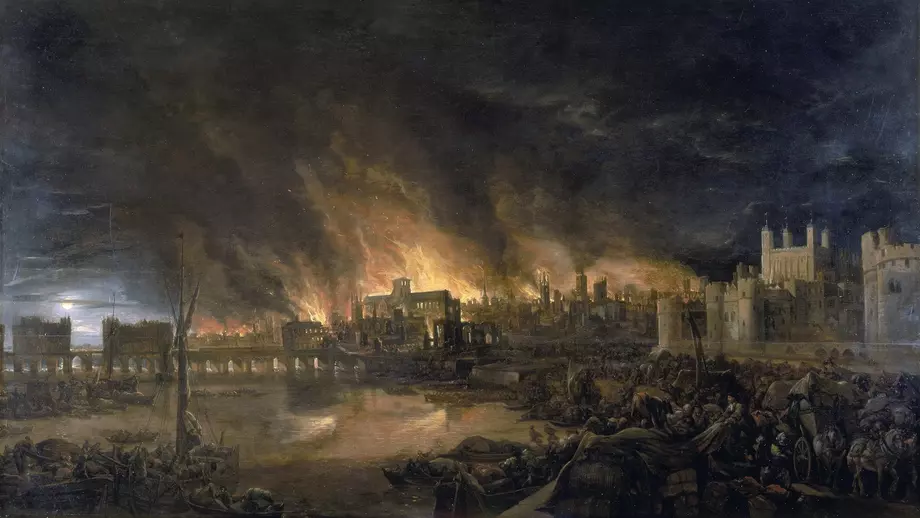
In the year 64 AD, during Nero's tenth year of rule, the Great Fire of Rome destroyed large parts of the city. It is considered the largest fire ever to rage in ancient Rome. Some sources suggest that Nero himself started the fire or had it started to make room for new palace buildings. However, there is no evidence for this.
The fire had far-reaching consequences. Followers of Jesus Christ were associated with the fire, leading to pogroms. The legendary apostle Peter is counted among the victims († around 65–67). He is said to have been in Rome around this time and worked there as the first pope ("Bishop of Rome"). However, this cannot be precisely traced based on historical documents. Today's St. Peter's Basilica in Rome is located above the presumed tomb of Peter.
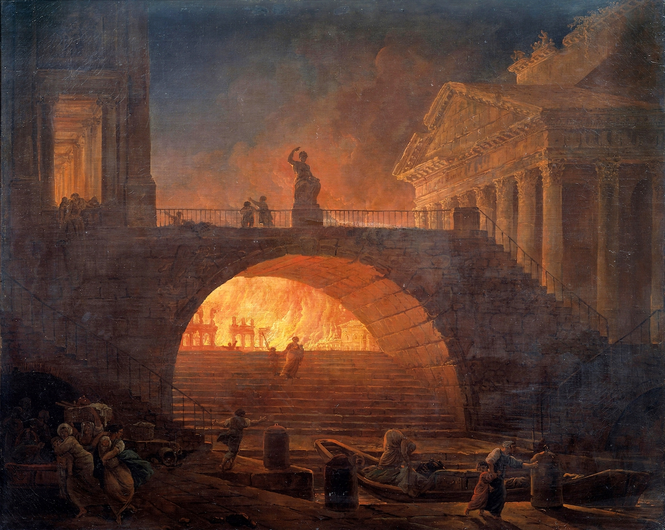
Large fires were not uncommon in ancient Rome, but this one was considered the most devastating. Early Christians interpreted it as an apocalyptic inferno, heralding the end times and the imminent return of the Messiah. Early Christians believed that the Messiah would appear within their lifetimes
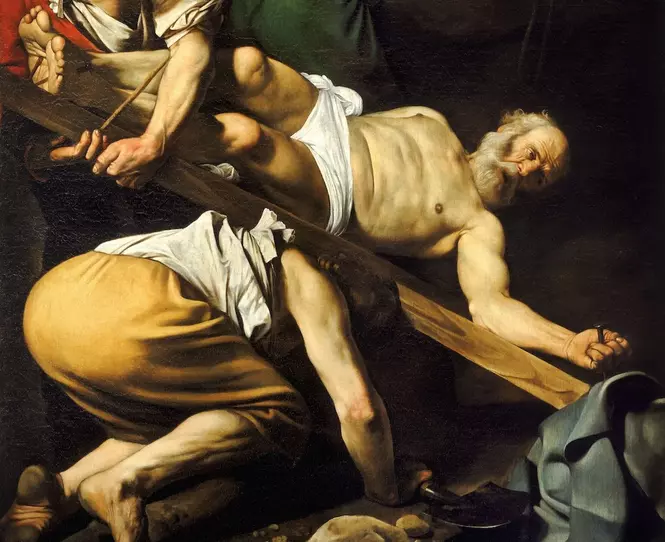
The Apostle Peter is considered the first Bishop of Rome and thus the first Pope. He is said to have been the most prominent victim of the persecutions of Christians following the Great Fire of Rome. According to legend, he insisted on being crucified upside down as he deemed it unworthy to die in the same manner as Jesus Christ. An inverted cross is hence referred to as the Cross of St. Peter

The structure, built by Donato Bramante, stands over the presumed crucifixion site of the Apostle Peter and is surrounded by a monastery. Bramante had previously collaborated with Leonardo da Vinci for many years at the Milanese court.
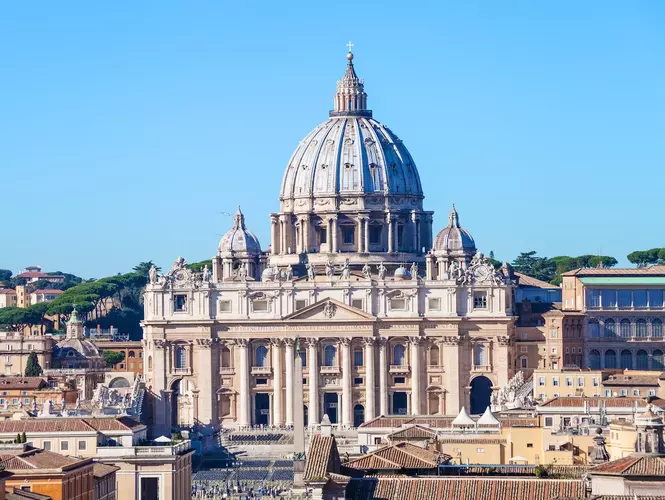
St. Peter's Basilica stands above the presumed tomb of Saint Peter. The original architect, once again, was Donato Bramante. Earlier sketches by Leonardo da Vinci bear a striking resemblance to the current St. Peter's Basilica, showcasing his significant influence on Bramante
The Destruction of the Temple of Jerusalem
The brutal persecutions of Christians were not the only consequence of the Great Fire. Emperor Nero now needed enormous sums of money to rebuild the capital Rome. The subsequent aggressive tax policy led to a major uprising in the Eastern Roman province of Judea in 66 AD. Nero brutally suppressed the uprising in the "Jewish War" (66-73 AD). During the war, the second Temple of Jerusalem was destroyed (70 AD, the first temple built by King Solomon at the site had already been destroyed by the Babylonians 500 years earlier). The Jerusalem Temple was by far the most significant Jewish temple in the ancient world. Jesus Christ is said to have preached there 40 years earlier. The Jewish Temple treasury was looted, brought to Rome, and paraded in a triumphal procession. The destroyed Temple of Jerusalem has not been rebuilt to this day. Nero himself did not live to witness the destruction of the highest Jewish temple.
Nero's Death
Nero revered ancient Greek culture throughout his life and left Rome in 66 AD for about a year to stay in the then Roman province of Greece. He participated in the Olympic Games and also performed publicly as an actor. This behavior of a Roman emperor was deemed unworthy in the eyes of the Roman nobility. After Nero's return from Greece, a broad alliance formed against the emperor, and he was declared an "enemy of the people." Fleeing to Egypt, he died on June 11, 68, on an estate near Rome. His bodyguard had already fled, and he was only surrounded by a handful of followers. When he heard his pursuers approaching, he stabbed himself in the throat with a dagger. Nero was only 30 years old. A particularly disgraceful punishment was that the memory of Nero was banned by decree ("Damnatio memoriae"). The mention of his name should be avoided ('he whose name must not be mentioned'), and he was erased from all annals, and all accessible portraits and inscriptions were destroyed.
Is Nero's given name the number of the Beast?
Nero had his closest relatives and wives killed; he ordered a war that destroyed the significant Temple of Jerusalem, and he brutally persecuted Christians. According to legend, even Peter, the politically most significant disciple of Jesus, fell victim to him. Besides, Rome went up in flames in an apocalyptic conflagration, which must have reinforced the contemporaries' impression that Emperor Nero was the embodiment of absolute evil. It is therefore highly likely that the 666 in the Book of Revelation refers to Emperor Nero, whose given name corresponds to the number of the Beast. The 666 would thus be an ancient code. For Hebrew-speaking contemporaries of John, it must have been clear that Emperor Nero was meant without directly naming him. On the other hand, the visionary and prophetic text of the Book of Revelation retains its timeless character by consistently avoiding the mention of historical figures, consciously refraining from narrating historically tangible events.
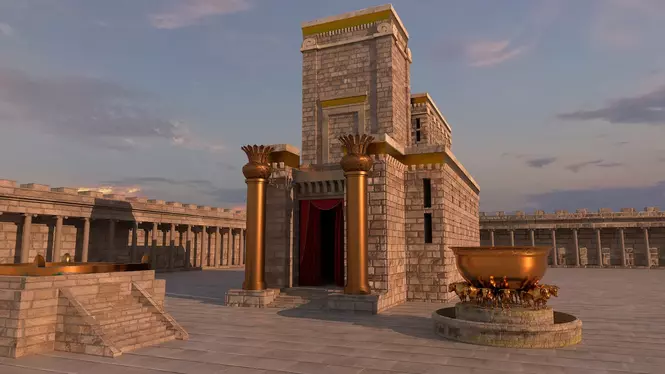
The temple was built under King Solomon. Solomon was the third king of Israel, following the legendary King David. He was famous for his wealth and wisdom. Jerusalem was conquered by the Babylonians under Nebuchadnezzar II in 597 BCE, and the residents were deported to Babylon (Babylonian Captivity). Solomon's Temple was subsequently destroyed (586 BCE)
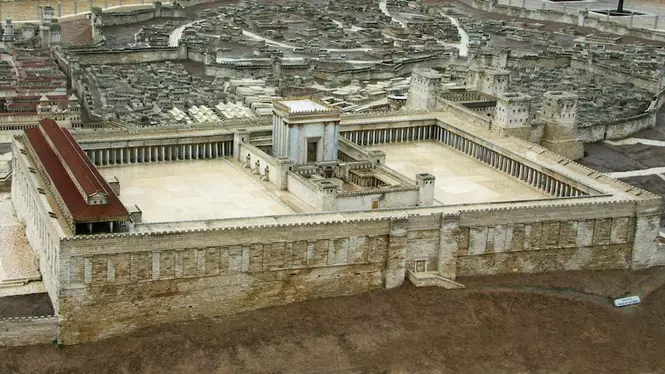
After the return of the Jewish people from the Babylonian Captivity, a new temple was built at the site of the old one. According to the Bible, Jesus Christ drove the merchants out of the temple here. The temple was last extensively expanded by the Roman client king Herod, who is mentioned in the Bible and is said to have ordered the massacre of infants in Bethlehem. The temple was destroyed by the Romans in the "Jewish War" and was never rebuilt thereafter
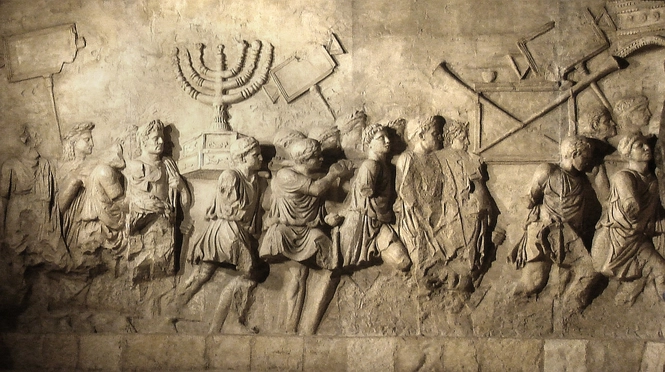
Titus was Nero's general in the Jewish War and later became Emperor himself (79-81 CE). After his death, his brother Emperor Domitian erected the Arch of Titus in his memory. The arch celebrates Titus's victory in Judea, especially the recapture of Jerusalem, and depicts the procession of the Jerusalem Temple treasures during a triumphal parade in Rome. The enormous seven-branched candelabrum, the Menorah, is said to have been mostly made of pure gold
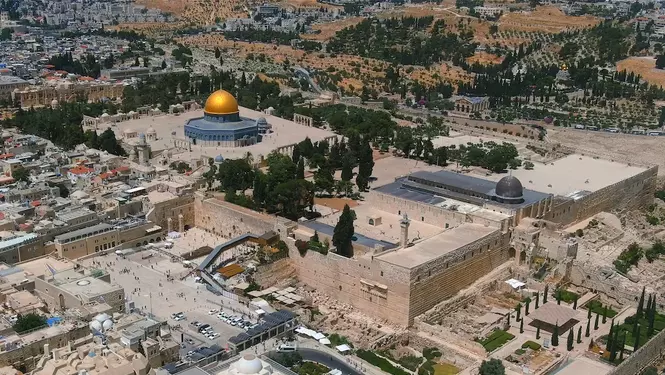
In 613 CE, the Eastern Roman Empire lost control of Jerusalem to the Persian Sassanids. In 637 CE, Jerusalem was conquered by the Muslims who built the Dome of the Rock (687-691, golden dome) and the al-Aqsa Mosque (706-717, gray dome to the right) on the remains of the Jerusalem Temple. As the Temple Mount is a sacred area, no excavations are conducted there. The only remaining structure from the Second Temple is the Western Wall ("Wailing Wall," on the left). The Temple Mount has been a site of ongoing conflicts between Jews and Muslims
The 666 in the Bible
In addition to the Book of Revelation in the last book of the New Testament, the number 666 is mentioned in only two other places in the Bible. Interestingly, in these instances, the number is not associated with personified evil but rather with multiplication, both in terms of increasing wealth and offspring.
The Wealth of King Solomon
King Solomon (also known as Salomon, in Hebrew: Schelomo or Schlomo) is a historical figure and the third king of the Israelite kingdom after Saul and David. He was the second child of King David and Bathsheba, reigning over Israel from around 970 to 931 BCE. His story is described in the Bible in the first book of Kings and the second book of Chronicles, making him one of the central figures in the Old Testament.
Solomon is primarily known for the wisdom granted to him by God, which he used to lead the kingdom of Israel into a prosperous era, making him immensely powerful and wealthy. He is most famous for constructing the first Jewish temple in Jerusalem, which was the first stone temple dedicated to the God of Israel. The Jerusalem Temple also housed the Ark of the Covenant, an elaborately crafted chest containing the two stone tablets with the Ten Commandments that Moses is said to have received from God on Mount Sinai.
The first mention of the number 666 in the Bible occurs in connection with the wealth of Solomon, listed during an encounter with the Queen of Sheba: "Now the weight of gold that came to Solomon in one year was six hundred threescore and six talents of gold" (1 Kings 10:14 and 2 Chronicles 9:13). The Hebrew representation of 666 is תרסו. These characters have no specific meaning but serve as a representation of the number 666. Therefore, the number is not to be taken literally and, if at all, holds a symbolic significance. The question arises as to why the chroniclers chose this particular number.
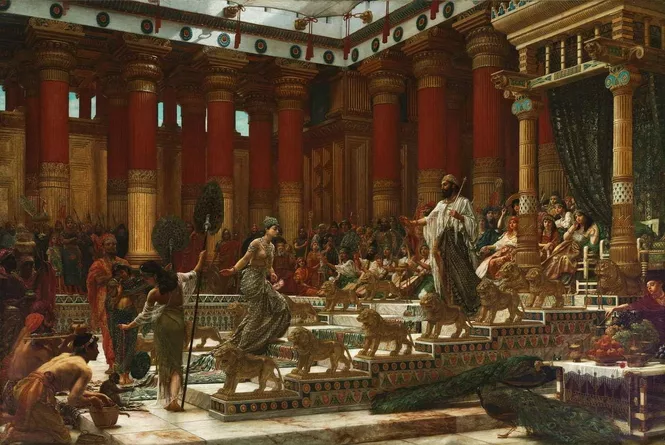
The visit of the Queen of Sheba is the occasion for a listing of the riches of King Solomon in the Bible. It is unclear today whether this encounter actually took place. Sheba was a kingdom in the southwestern part of the Arabian Peninsula, present-day Yemen. It was a significant trading center for spices, frankincense, gemstones, and other precious goods
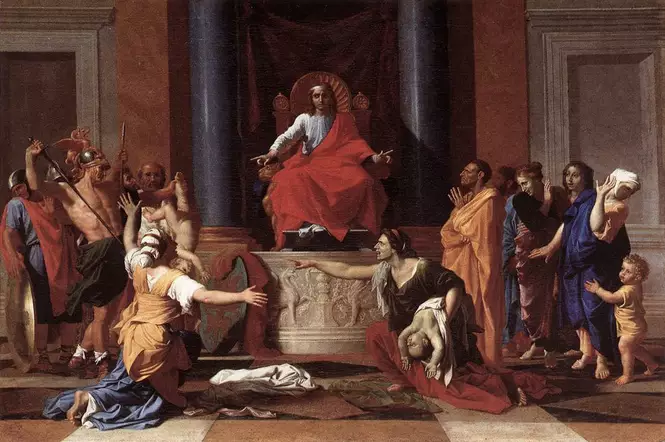
The judgment is the most well-known episode from Solomon's life. Two harlots lived in a house and became mothers at the same time. Shortly after the birth, one of the two sons died in the night, and the mother of the deceased child secretly exchanged it for the living one of the other. In the morning, both women argued over the child. The dispute reached Solomon, and he decided to divide the child with a sword. When the true mother begged to give the child to the other, Solomon recognized that she must be the real mother and awarded her the child
The Book of Ezra
The story of Solomon is told in the first book of Kings. The subsequent second book of Kings ends with the Babylonians capturing Jerusalem and the Israelites being carried off to Babylon (Babylonian Captivity). In the following book of Ezra, the number 666 is mentioned again. In a list of those returning from the Babylonian Captivity, a man named Adonikam is mentioned, who had the impressive number of 666 descendants (Ezra 2:13). The high number of descendants is not unusual in comparison. The other returnees had between 42 and 3630 descendants. It is a characteristic of biblical texts to often give numbers a symbolic meaning.
Conclusion
Apart from the New Testament's 666 in the Book of Revelation, the number 666 is mentioned only two more times in the Old Testament. In those instances, the number does not have a negative character and is associated with multiplication. Once in the multiplication of the wealth of King Solomon, who far exceeded his predecessors David and Saul, earning 666 talents annually, and the multiplication of Adonikam, who could boast the impressive number of 666 descendants. It is noteworthy in this context that 666 has an interesting mathematical property—it is a triangular number—which might be the reason why the authors of the Old Testament chose this particular number.
The triangular number 666
666 is a triangular number. Triangular numbers are generated by continuously adding consecutive natural numbers (see table).
The term "triangular number" refers to the graphical representation of these numbers (see graphic). Initially, the value 1 is placed in the first row, but 1 is not yet a triangular number. In the row below, the ones from the row above are taken, and the value 1 is added. If this step is repeated several times, a triangular pattern emerges. The sum of the values in a row, added to the sums of the values in all rows above it, is referred to as a triangular number.
The term "triangular number" thus describes the geometric shape that results from the arrangement of the numbers.
| Calculation | Triangular number |
| 1 + 2 | 3 |
| 1 + 2 + 3 | 6 |
| 1 + 2 + 3 + 4 | 10 |
| ... | |
| 1 + 2 + 3 + 4 + ... + 35 + 36 | 666 |
Here are the first 35 triangular numbers from 3 to 666, where each row adds one more "1." In the 36th row, there are 36 "1s" in a row. The triangular number 666 is then the sum of all the values in this row, added to the sums of the values in all the rows above it. Note that "1" itself is not considered a triangular number
Were the chroniclers of the Old Testament using numerical symbolism?
The number 666 is special because it is a triangular number, representing a continuous increase of a specific value, with each row adding 1. Chroniclers may have chosen this number to highlight the continuous growth of the wealth of the Israelite people under King Solomon, which had already begun under Solomon's father, King David.
The chroniclers of the Bible frequently incorporated symbolic numbers into their writings (e.g., 3, 7, 12, or 144 (the square of 12)). They were likely familiar with triangular numbers as well, as they follow a simple pattern and could have been known to various ancient cultures. The choice of 666 among all triangular numbers may be due to the unique equality of units, tens, and hundreds places in this sequence. It is interesting to note that only two previous triangular numbers, 55 and 66, also have equality in their digits. These could symbolically represent the two predecessors of Solomon, Saul and David, who were wealthy but not as rich as Solomon. According to tradition, Solomon surpassed them by a significant margin. Additionally, it is noteworthy that the apex of the triangle forms the number 1, which does not explicitly belong to the triangular numbers. In this case, it is plausible to recognize it as God, according to biblical understanding as the origin of everything.
Additional number sequences with the sum of 666
144 decimal places of the number Pi
The first 144 decimal places, when added, result in 666. Even though this is a coincidence, it is an interesting one, especially considering that in the biblical context, the number 12 and its square, 144, play a significant role. In the Book of Revelation, there are 144,000 individuals from the 12 tribes of Israel (12 tribes * 12,000 each, Rev 7:4), who are particularly protected by God and likely the same 144,000 who ultimately stand with the Lamb on Mount Zion and have been redeemed (Rev 14:1). The number Pi connects, in a mystical, divine, or coincidental manner depending on one's perspective, the number of the redeemed, which is 144, and the number of the beast, which is 666. The significance of 144,000 as the number of redemption is particularly emphasized by Jehovah's Witnesses, a Bible-based religious group that originated in the United States around 1870 and has followers worldwide.
The number Pi with its 144 decimal places in groups of ten:
3.1415926535 8979323846 2643383279 5028841971 6939937510 5820974944 5923078164 0628620899 8628034825 3421170679 8214808651 3282306647 0938446095 5058223172 5359
The squares of the first seven prime numbers
The sum of the squares of the first seven prime numbers is 666.
| Prime number | 2 | 3 | 5 | 7 | 11 | 13 | 17 | |
| Square number | 4 | 9 | 25 | 49 | 121 | 169 | 289 | = 666 |
Here, too, it is an interesting coincidence that the number 7 (7 creation days, 7 seals, etc.), another highly significant number in the Bible, is associated with 666.
Six, Six, Six in Popular Culture
The number 666 is highly popular in pop culture. Pop culture is primarily an expression of youth, specifically from adolescence to the transition into adulthood. During this phase, young people seek identity, self-expression, and community. Music, fashion, movies, and other cultural elements play a crucial role in reflecting the feelings, challenges, and values of this particular age group.
- In art-oriented forms of expression that utilize language as a creative tool, the phonetic similarity between "six" and "sex" in many languages (Swedish, French, German, English) is often used for wordplay
- In music, numerous examples can be found where artists, especially in the rock and metal genres, use the number 666 in song titles or lyrics to create a dark or rebellious atmosphere
- In films and television series, 666 is also frequently employed as a powerful symbol for the eerie and supernatural.
It is important to emphasize that the use of 666 in pop culture is often a stylized and dramatized representation aimed more at entertainment than actual satanic beliefs. Therefore, it is surprising that many young people adopt symbols like the number 666, the devil's hand sign, or forming three sixes with fingers over the eye as fashionable without necessarily understanding the deeper meaning behind them.
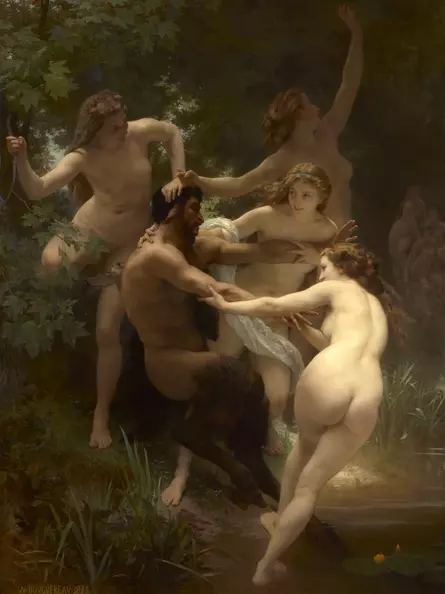
A satyr is a lascivious woodland spirit from the retinue of the Roman god of wine, Bacchus. Since the 15th century, the legs of a satyr have been depicted as hind legs of a horse, pointing to the animalistic lustfulness of its lower body. Additionally, with small horns on its head, it strikingly resembles the medieval conception of the devil

When, as shown here, the circularly shaped index finger and thumb enclose the right eye, it additionally refers to the symbol of the All-Seeing Eye. Originally a religious symbol for the "Eye of God," later adopted by the Freemasons, a humanistic secret society from the 18th century, as the "Eye of Providence," it is now a symbol used mainly by pop stars and followers of conspiracy theories as fashionable poses or symbols. However, many of them are unaware of its actual meaning.
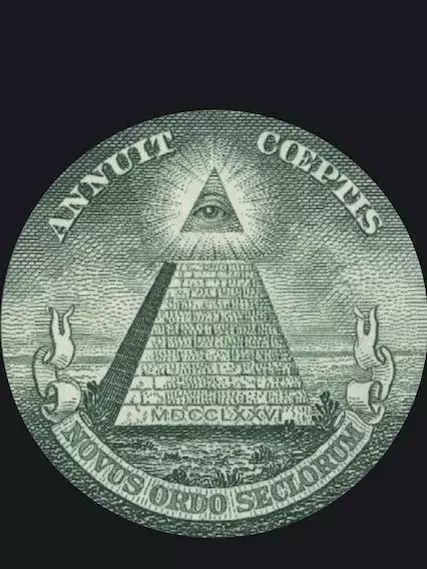
The U.S. national emblem with the "Eye of Providence" is found, for example, on the 1-dollar bill. A distinctive feature of the depiction is the connection of the eye within a radiant triangle and a pyramid. This configuration is unique to the Great Seal of the United States. The Founding Fathers of the USA were predominantly Freemasons. Overlooking the hills of Washington D.C. stands the monumental Masonic temple "George Washington Masonic National Memorial.
The Number 666 and Conspiracy Theories
The number 666 is often associated with conspiracy theories. The basic idea is that conspirators, who are supposedly visible to everyone but still unrecognized, use the symbolism of 666, e.g. in company logos, fonts, and paintings. However, a closer look shows that these interpretations are incorrect. Here are some examples:
- INTERNET
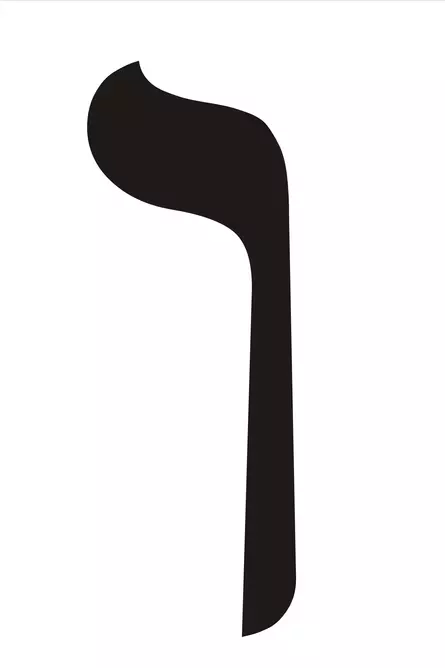
The Hebrew letter "Waw" has the numerical value 6 and corresponds to the Latin letter "w" in languages such as English, French, and German. WWW is the abbreviation for World Wide Web and was prefixed to many domains as a subdomain, especially at the beginning of the internet. "www" is then supposed to be read as 666. However, it is overlooked that the biblical number 666 is defined in the Bible as six hundred and sixty-six (600+60+6). Read as a Hebrew numerical value, "www" would only yield 6+6+6 = 18 - MONSTER ENERGY
"Monster Energy" is very popular especially among young people (market capitalization 12/2023: about 50 billion euros). The company logo, which is prominently displayed on all of the company's beverage cans, refers to the eponymous monster, which has torn open a can, for example, with three of its claws. On the other hand, the image is strikingly similar to the Hebrew letter "Waw", which would then be represented three times next to each other as a numerical value of 6. Thus, the three sixes on the can could be understood in the Christian-influenced USA, the country of origin of the brand, as a warning against the invigorating but potentially harmful effects of the highly sugary energy drink and would thus be more of a hidden marketing gag. It is also important to mention here that three times the numerical value of Waw (6+6+6 = 18) does not correspond to the value of six hundred and sixty-six - MONA LISA PRADO
Art objects in large collections are cataloged with a consecutive number. Especially less valuable objects are often only stored and not hung in private rooms or exhibited publicly. In these cases, it is not uncommon for the catalog number to be located directly on a painting. This allows them to be identified more quickly in the archives. When numbering, a "catalog number 666" can also occur. Conspiracy theorists then want to attribute a special meaning to these objects. For example, the painting "Mona Lisa Prado", from the workshop of Leonardo da Vinci, once bore the catalog number 666 (now 504), which was applied in the lower left corner of the painting - WALT DISNEY
The logo of the US entertainment company Walt Disney uses a very decorative font. Some conspiracy theorists interpret three of these decorations as sixes, which together are supposed to have the meaning of 666. They overlook a fourth six, so that, if at all, not 666, but 6666 would be hidden in the logo. However, 6666 has no meaning in the Book of Revelation

The green logo of Monster Energy is designed to look like the claws of a monster that has ripped open the can. The pattern created by the claws resembles the Hebrew letter "Waw", which appears three times in the logo. The most distinctive feature of the letter "Waw" is its "head" (the top bar), which points to the left
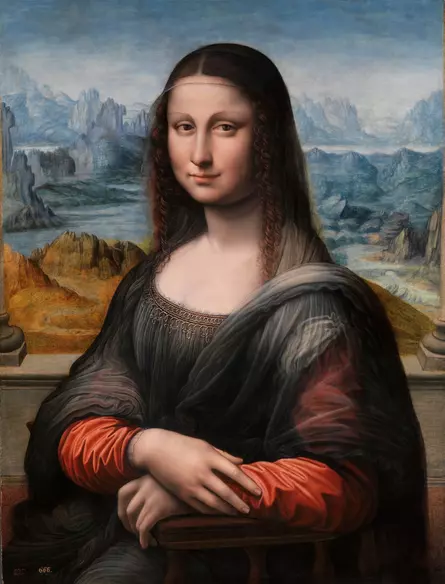
The painting was created parallel to Leonardo da Vinci's Mona Lisa, as it could be shown that some overpaintings are exactly the same. It is attributed to Leonardo's student Francesco Melzi, who copied his master's work at the same time. The character of the painting changed fundamentally after a restoration in 2012. Previously, the background had been completely overpainted in black at a later time, as the work was considered an insignificant copy
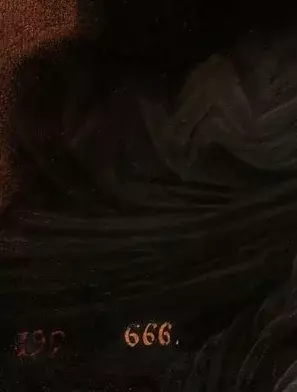
The 666 is the result of a later overpainting. Paintings that were considered to be less valuable were often numbered in the visible area with consecutive numbers in the collections of the nobility in order to catalog them and find them again in the archives. When the painting changed ownership, the catalog number changed. Thus, the catalog number 199 is located to the left of the 666. The painting was also numbered several times on the back

The lettering has been unchanged since the company was founded in 1923. Ornate fonts were modern as company logos at the time, similarly ornate are e.g. the logos of the New York Yankees, Coca Cola or Ford.
Disney's logo is often associated with the 666. Three curlicues of the letters are interpreted as sixes (red). However, it is then overlooked that on closer inspection there are at least four curlicues (green). It would therefore not be a 666, but a 6666 represented as a hidden number. In addition, the "D" can also be read as a vertically mirrored 6, as can the right part of the "W"
Buying or selling could only be done by those who bore the mark: the name of the beast or the number of its name